Home

Navigation principale

  • Who we are
    • General presentation
    • Becoming a member
    • The team
    • Contact
  • Members
  • Fellows
  • Initiatives
  • Calls for applications
  • Events
  • Ressources
29.06.2026
University of Konstanz (A 704)

Alumni Lecture 2026: Multilingual minds and mindsets: Chances and challenges

Speaker

Tanja Rinker (Alumna/Linguistics)

Abstract

Globally, multilingualism is the norm, yet monolingual practices and beliefs continue to persist. Tanja Rinker’s work addresses this discrepancy by advancing our understanding of multilingual language processing and development, to lay the bases for informed decisions on language assessment and intervention.

In this talk, she will present three strands of her research: (1) neurophysiological foundations of bilingual language processing, (2) the development of an innovative AI-powered assessment tool for multilingual children, and (3) teachers’ beliefs and classroom practices in multilingual contexts. These strands draw on projects and collaborations initiated or conducted during her time at the Zukunftskolleg.

Organizer
Zukunftskolleg

Zukunftskolleg
14.06.2026 17.06.2026

Visit of Turku Institute for Advanced Studies

Speaker

Sasha Nenko, Özlem Celik, Ranjana Saha and Peter Szegeti

Presentations by:

  • Sasha Nenko, TIAS collegium member, Landscape Studies current topics around: urban studies/urban sociology/anthropology, anthropology of place, emotional/participatory mapping, studies of creative collectives,cultural creative industries https://www.utu.fi/en/people/oleksandra-nenko
  • Özlem Celik, TIAS Collegium Fellow, Sociology, current topic: "The Emergence of Municipal-led Green Financialisation of Urban Development in Sweden and Finland"  https://www.utu.fi/en/people/ozlem-celik
  • Ranjana Saha, Senior Research Fellows, History, current topic "Mothers, Mothercraft & Materialities: Urban India and Transnational Histories of ‘Scientific’ Motherhood in the Nineteenth and Early-Twentieth Centuries" https://www.utu.fi/en/people/ranjana-saha
  • Peter Szegeti, TIAS Collegium Fellow, Law, current topic "Development of an ecologically sustainable system of private law" https://www.utu.fi/en/people/peter-szigeti
  • Martin Cloonan, Director TIAS, former Professor of Popular Music politics expertise on "The political economy and history of the music industries, live music, popular music policy, freedom of expression, popular music" https://www.utu.fi/en/people/martin-cloonan
Aarhus Institute of Advanced Studies
09.06.2026
Aarhus University Høegh-Guldbergs Gade 6B DK-8000 Aarhus C Denmark

Bridging knowledge: the dynamics of interdisciplinarity

What happens after we conclude that our research question cannot be answered from just one shore? That true progress demands a bridge built from ideas, languages, and methods of different disciplines? This one-day event invites you to step into the construction site of interdisciplinarity.

Inspired by the art and engineering of bridge-building, we will reflect on what it might take to create and sustain strong and resilient connections in research.

Together, we will explore the different stages of this process: sketching the ideas and laying the foundations of shared understanding, assembling complementary expertise, designing integrated research, maintaining the bridge over time, and opening it to the public.

Join us for this unique opportunity to hear from experienced researchers about these aspects and to engage in a collective discussion on interdisciplinary collaboration.

PROGRAMME

TUESDAY 9 JUNE 2026

08:30-09:00

Networking and informal introductions

09:00-09:15

Welcome by organizer Bruna Neves de Freitas

09:15-09:30

Introduction: The power of interdisciplinary connections presented by Andreas Roepstorff

09:30-10:00

Laying the foundations: From spark to structured idea presented by Peter Dalsgaard

10:00-10:30

Finding the gap: Identifying problems that need bridges (and have an extra challenge) presented by Christine Parsons

10:30-10:45

Coffee Break

10:45-11:45

Building the Pillars: Assembling complementary expertise
15-minute presentations given by Mette Terp Høybye, Jens Vinge, Lotte Larsen and Rubens Spin-Neto

11:45-12:15

Panel discussion

12:15-13:15

Lunch

13:30-14:15

Constructing the framework: Incorporating complexity and designing integrated research. 
15-minute presentations given by Lene Baad-Hansen, Antoinette Mary Fage-Butler and Janne Flora

14:15-14:30

Panel discussion

14:30-14:45

Coffee Break

14:45-15:15

Strengthening the beams: Team collaboration practices presented by Helle Alsted Søndergaard

15:15-15:45

Opening the bridge: Sharing interdisciplinary work presented by Ruben Pauwels

15:45-16:00

Closing remarks

REGISTRATION

Registration is now open. Please register here.
The conference is open to all. Participation in the workshop is free of charge, but participants will need to cover their own travel and accommodation expenses.

ORGANIZERS

The conference is organized by AIAS-AUFF Fellow Bruna Neves de Freitas and AIAS Associate Fellow Mette Terp Høybye.

CONTACT

Bruna Neves de Freitas, 
AIAS-AUFF Fellow

E-mail: brunanfataias [dot] au [dot] dk (brunanf[at]aias[dot]au[dot]dk) 

Zukunftskolleg
21.05.2026 11.12.2026
Online

UBIAS Talk Series for Early Career Researchers

From Fellow to Future

A series of curated conversations offering twin perspectives on early-career support at university based Institutes for Advanced Studies (UBIAS)

The UBIAS seminar series consists of short curated conversations offering twin perspectives on early-career research at Institutes for Advanced Study globally: "ECR Individual Success" and "Institutional Growth".

University based Institutes for Advanced Study provide a special academic environment and freedom to research in a likewise crucial and creative phase – without offering a permanent position.
In this context, the ECR perspective focuses on career development, grant writing, publication pressure and global networking, while the IAS perspective centres on interdisciplinarity, excellency, talent acquisition, community building, and enhancing university presence.

The series is likely to be of interest to doctoral students seeking their first postdoctoral positions, early-career researchers, staff at IASs and their associated universities, current Fellows, IAS alumnae/i and potential applicants. Future sessions will explore interdisciplinarity, mentoring, and making an academic career.

Further information on the network of university based Institutes for Advanced Study, its activities and the 47 members across the world can be found at http://www.ubias.net/. The 2026 Topic of the Year “The Future of Knowledge Production” encourages all members to open space for intellectual debates and contribute with events.

The events will be live on ZOOM. Recordings are available afterwards on the UBIAS website and YouTube channel.

https://uni-konstanz-de.zoom.us/j/65153538563?pwd=YxrFacSfBjxqYrXhga7bKL4ujrpqyb.1
Webinar-ID:  651 5353 8563 
Passwort: 061266

Planned programme

Talk 1: Recruitment & Onboarding, 21 May 2026, 15:00-15:30 BST / 16:00-16:30 CET

Talk 2: Mentorship, 8 June 2026, 14:00–14:30 CET

Talk 3: Research & Interdisciplinarity, 16 September 2026, 13:00-13:30 CET

Talk 4: Career Development, 5 October 2026, 17–17.30 CET

Talk 5: Peer-to-Peer Network, 25 Novemer 2026, 16:30-17:00 CET

Talk 6: Alumni& Network asset Building, 11 December 2026, 08.00 am (BR Time / 12:00 CET)

More information
poster_ubias_talkseries2026_fromfellowtofutureb_no-logo.pdf
Freiburg Institute for Advanced Studies
20.05.2026
Georges-Köhler-Allee 401a 79110 Freiburg

FRIAS Project Group: Agrivoltaics

About the Event

Agriculture or solar power? When acreage is limited, the question often arises as to which takes precedence. Agri-photovoltaics (Agri-PV) combines electricity generation via photovoltaics with agricultural crop production on a single plot of land and is regarded as a promising approach that is increasingly being researched internationally. The “Agrivoltaics” project group, funded by the Freiburg Institute for Advanced Studies (FRIAS), has been investigating this potential since October 2025 in collaboration with researchers from the University of Freiburg and the Fraunhofer Institute for Solar Energy Systems ISE. At the heart of the project is a demonstrator developed under the leadership of the Centre for Renewable Energy (ZEE) at the University of Freiburg, which is part of the project group. The demonstrator will be inaugurated on 20 May 2026 on the grounds of the Faculty of Engineering.

About the Demonstrator

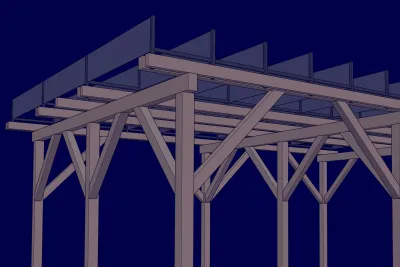
The demonstrator is located directly opposite the Europa-Park Stadium and, together with information boards, serves as an eye-catching feature designed to spark public interest in the topic of agri-photovoltaics. On this test site, crops are grown beneath photovoltaic modules that are positioned so that shading occurs mainly in the afternoon – that is, at a time of day when it can protect the plants from high temperatures and drought stress. Research is being conducted into the effects of the agri-PV system on the microclimate, plant growth and electricity yield. As part of the monitoring process, sensors record, among other things, light availability, air temperature, soil moisture and humidity beneath the system and compare these values with an unshaded reference area.

For whom?
All interested welcome. No registration needed.

Contact
E-Mail: kommunikationatzv [dot] uni-freiburg [dot] de (Max Beyer)
Phone: +49 (0)761 203-4302

More information

https://uni-freiburg.de/frias/project-group-agrivoltaics/

Madrid Institute for Advanced Study
29.09.2025
Madrid, Casa de Velasquez

Human / non human

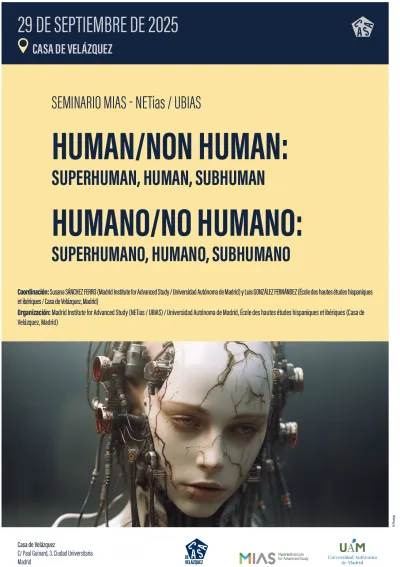
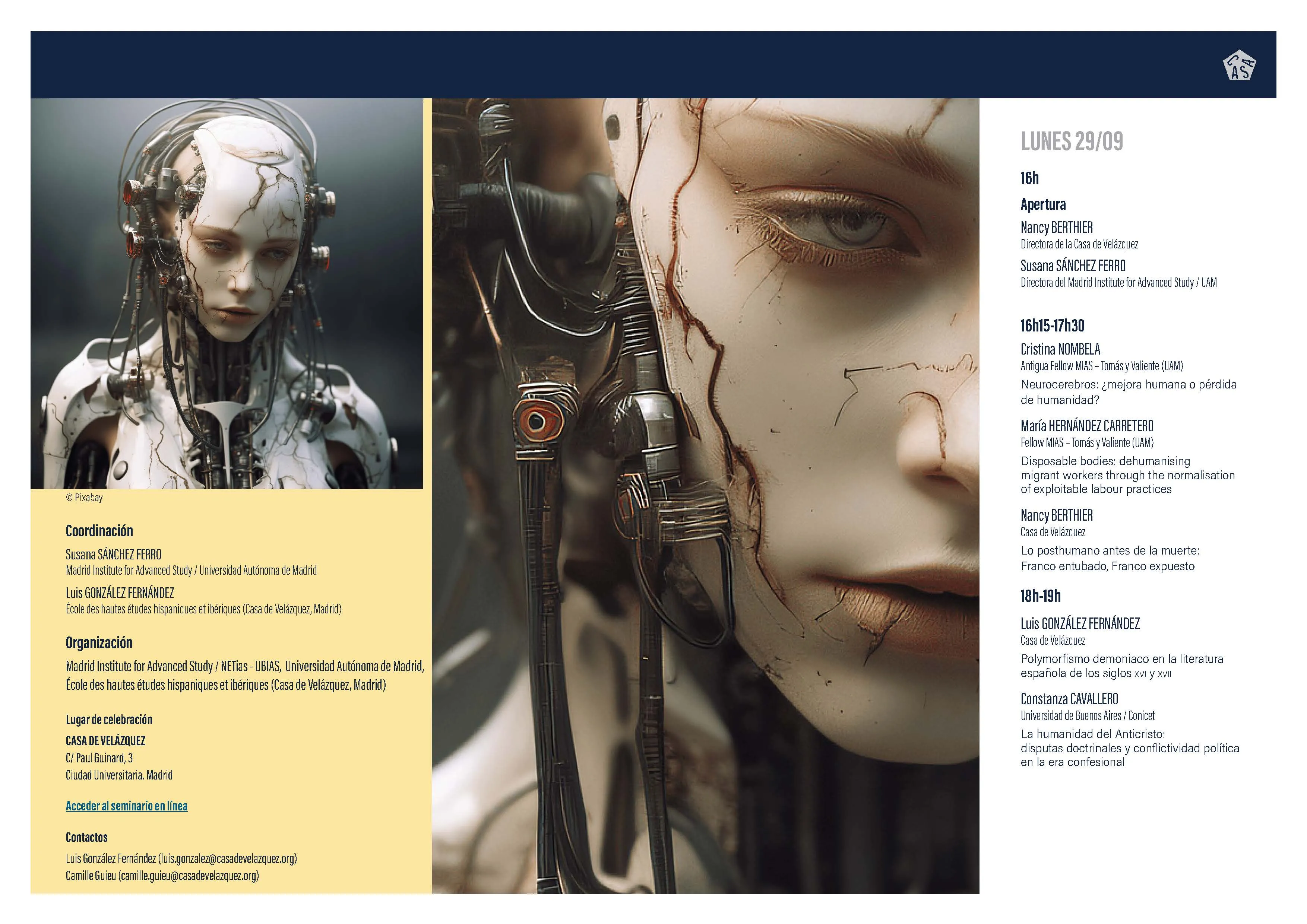
The seminar Human/Non-human: superhuman, human, subhuman proposes a critical reflection on the boundaries and redefinitions of the human through different historical, political, scientific and cultural contexts. Starting with disturbing images such as Eugène Thivier’s Le Cauchemar, the presentations will address figures of transhumanism, contemporary dehumanisation and the limits of the political and symbolic body. From augmented brains to exploitable bodies, via the exhibition of a dying dictator, forms of disarticulation of the human condition will be analysed. The second session will transport us to the Golden Age and the confessional era, exploring the demonic and the anti-Christian as figures that strain humanity. An interdisciplinary encounter that invites us to think about the instability of the concept of “human".

27.09.2025
Volkstheater, Arthur-Schnitzler-Platz 1, Wien, 1070

Who Can Speak? Reflections on Social Movements and Their Limits

The theme of the Vienna Humanities Festival 2025 is “On Edge/Unbehagen.” 

Life-changing technological innovation is advancing at an often unpredictable pace. Liberalism is under sustained attack, as is faith in basic scientific principles. Compassion is increasingly displaced by brutal transactional values. Can humanity remain human under such strenuous circumstances? The Vienna Humanities Festival will invite the public to reflect with intellectuals, scientists, writers, and artists.

Life-changing technological innovation is advancing at an often unpredictable pace. Liberalism is under sustained attack, as is faith in basic scientific principles. Compassion is increasingly displaced by brutal transactional values. Can humanity remain human under such strenuous circumstances? The Vienna Humanities Festival will invite the public to reflect with intellectuals, scientists, writers, and artists.

Renowned French sociologist and author Didier Eribon returns to the questions at the heart of his book The Life, Old Age, and Death of a Working-Class Woman (Semiotext(e), 2025). Invoking the condition of elderly individuals who have lost their physical autonomy, and with it the capacity to participate in political mobilization, Eribon explores the broader issue of political voice and visibility: what conditions determine who is able to speak out politically?

After the talk, Eribon will be in conversation with Ivan Krastev, IWM Albert Hirschman Permanent Fellow.

Event on the IAS page
18.09.2025 19.09.2025
Uppsala

Jubileum celebration

This year SCAS celebrates its 40th anniversary since the inception of the Collegium in 1985. SCAS uses this milestone to look forward — to examine how Institutes for Advanced Study (IASs) can continue to foster free, independent, and interdisciplinary scholarship in an increasingly complex and evolving academic and global environment.

The jubilee symposium is on the theme Transitions: Future Trajectories of Institutes for Advanced Study (IASs) in Academia.

Jubileum symposium - Transitions: Future Trajectories of Institutes for Advanced Study (IASs) in Academia

The world of academic scholarship and science is currently undergoing significant change — in terms of organization, funding structures, mobility, and forms of collaboration. Questions around academic freedom and integrity are being reshaped in many regions, and Institutes for Advanced Study, are facing new challenges as well as new responsibilities. The symposium will reflect on these developments and explore how IASs can remain resilient, relevant, and responsive in supporting curiosity-driven research beyond institutional and disciplinary boundaries.

17.09.2025 20.09.2025
Uppsala

SCAS Hosted European Network and Celebrated Milestone Anniversary

Last week, the Swedish Collegium for Advanced Study was the arena for two large events.

First, SCAS hosted the annual meeting of the Network of European Institutes for Advanced Study (NetIAS) as we welcomed colleagues from our sister institutes across Europe for discussions on ongoing initiatives, future collaborations, and shared opportunities and challenges.

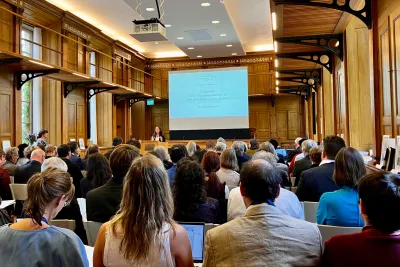
The network meeting was instantly followed by the 40th anniversary celebrations of the Collegium, which saw invited guests gather for an international symposium on the theme Transitions: Future Trajectories of Institutes for Advanced Study (IASs) in Academia. Speakers and participants attended from near and far and contributed to vibrant and stimulating discussions on the unique role of Institutes for Advanced Study and topics such as academic freedom, interdisciplinary collaboration, global mobility, the support to early-career researchers, institutional purpose, academic diplomacy, and the evolving conditions for research, among other things.

25.06.2025
Hamburg

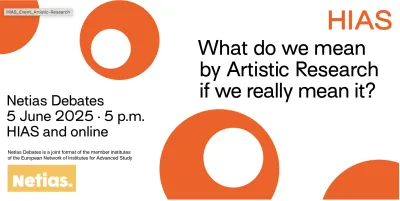
Netias Debate: What do we mean by Artistic Research if we really mean it?

Participants

Six fellows working on Arts & Sciences/ Artistic Research projects and coming from five different Institutes for Advanced Study all over Europe share the thoughts and insights of their three-day common reflexion at HIAS:

  • Wulan Dirgantoro (HIAS, Hambourg)
  • Clemens Krauss (ZiF, Bielefeld)
  • Massimo Leone (HIAS, Hambourg)
  • Alex South (IASH, Edimbourg)
  • Rania Stephan (Iméra, Marseille)
  • Jason Waite (HCAS, Helsinki)

The exchange revolves around some key questions like: Can arts and sciences be seen as two separate epistemologic domains? Does art oppose science/scholarship? What is the relationship between them: is it linear, circular, superimposed…? What kind of questions are asked by art, by sciences? What drives the curiosity that is at the origin of the desire to research in both spheres?

“[…] Artistic Research has the unique capacity to operate within ambiguity, to render nuances that resist the grammar of academic prose, and to give form to paradoxes that scholarship often struggles to name. Some twists of human reality—subtle tensions of identity, affect, embodiment—cannot be said, only shown; not explained, but staged, enacted, or refracted. It is here that art becomes a form of thinking, not after or beside science, but with it—at times, even ahead of it. […]“

Massimo Leone: Glimpses, Glitches, Glyphs. Hambuurg 2025.

The event takes place Thursday, June 5th at 5pm.

If you would like to participate online, please send an e-mail to: eventathias-hamburg [dot] de (event[at]hias-hamburg[dot]de).

01.10.2024

2023 laureates of the Constructive Advanced Thinking Programme

The 2022 Constructive Advanced Thinking Programme Selection took place on January 18, 2023. 

4 new groups were selected !

The four groups of laureates for the year 2023 are:
  • Rossella Alba Group on "Controversial tools: researching modelling practices in water governance"
    Hosting IAS: Mak’it, SCAS , Paris, NIAS
     
  • Allassonnière-Tang Group on "Unraveling the interactions between culture and language: Does grammatical gender foster gender inequality and vice versa? "
    Hosting IAS:  Paris, IIAS, MIAS, HIAS, Zukunftskolleg, NIAS
     
  • Lemoine-Schonne Group on " Metamorphoses of Law(s)?  A critical exploration of planetary boundaries and their meaning for the law relating to the environment "
    Hosting IAS: Paris, IIAS, Mak’it, TURIN , NIAS, CEU
     
  • Kathryn Roberts Group on "A Transformation Framework for Artist Residencies, based on Internal Critiques, Alternative Histories, and Emerging Practices "
    Hosting IAS: MIAS (Twice) , Mak’it, HIAS

For more information on the programme, please check the dedicated page.

fellow's profile
Institute for Advanced Study at Central European University
29.11.2023
Online/Budapest

Language-based Assessments (LanBAs)

LOCATION: Budapest, Nádor u. 15, Room 103

Zoom: https://ceu-edu.zoom.us/j/91802517745?pwd=aVZZMjF6QXFaKzNVbVJyam5FaW15Zz09; Meeting ID: 918 0251 7745; Passcode: 585943

Linguistic behavior serves as a reliable, inexpensive, and increasingly automated resource to assess different aspects of individuals and societies. Speech helps detect incipient health issues; newspaper corpora are used to identify stereotypes and societal biases; and wordlists are the basis to determine verbal development. However, these and other relevant developments (which we label language-based assessments or LanBAs) have been concocted, tested, and deployed primarily on a handful of large and commercially central languages, with English dominating the scene. Since the 6,500 extant languages can and do vary substantially, transferring LanBAs from English to them is fraught with technical and linguistic challenges. The consequences of this bias, which we are only starting to understand, is that users of minority languages have at their disposal more expensive, less efficient, and potentially biased LanBAs. A novel source of worldwide inequity looms large across multiple social arenas. We propose to address this issue by gathering a diverse set of experts with three main tracks of activity: (1) critically synthesizing the scientific evidence revealing the Anglophone bias in LanBAs, (2) engaging policy-makers, experts on language technologies, and other non-academic agents, and (3) transferring knowledge to the general audience through diverse media strategies.

Speakers:

Damian Blasi – team leader/Harvard University, USA – Max Plank Institute for the Science of Human History, Germany – Higher School of Economics, Russia

Joseph P. Dexter  - Data Science Initiative and Department of Human Evolutionary Biology,  Harvard University

Adolfo Martín García  - Director, Cognitive Neuroscience Center, Universidad de San Andres, Argentina

Camila Scaff – Postdoctoral Researcher - Human Ecology group, Institute of Evolutionary Medicine (IEM), University of Zurich,

Amber Gayle Thalmayer - Assistant Professor, Department of Psychology, University of Zürich

Please see the project description here.  The presentation is a part of the short visit planned and scheduled within the Constructive Advanced Thinking (CAT) programme an initiative of NetIAS and coordinated by the IAS CEU.

10.10.2023 12.10.2023
Konstanz, Germany

2023 meeting of Directors hosted by the Zukunftskolleg

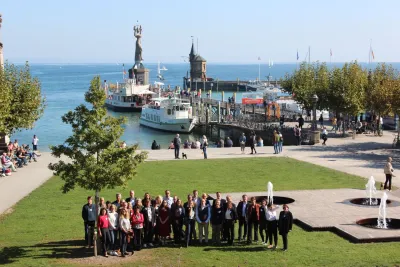
The European Institutes for Advanced Study met in Konstanz for their annual meeting to foster cooperation. The participants discussed new and ongoing Netias projects ranging from the programme CAT (Constructive Advanced Thinking) to the network’s debate series (Netias Debates) or different working groups on themes of common interest.

The European Institutes for Advanced Study (EURIAS) recently convened in the picturesque city of Konstanz for their annual meeting, a gathering designed to strengthen cooperation and foster intellectual exchange among its member institutions. This meeting served as a vital platform for scholars and researchers to share insights, explore collaborative opportunities, and address the challenges and successes of their respective projects. The event underscored the importance of interdisciplinary cooperation in driving innovation and advancing knowledge across various fields of study.

During the meeting, participants delved into discussions on a range of initiatives under the Netias umbrella, showcasing both new and ongoing projects. One of the highlights was the Constructive Advanced Thinking (CAT) programme, which aims to promote innovative and forward-thinking research. The CAT programme encourages scholars to tackle complex issues with creative and unconventional approaches, fostering a culture of intellectual risk-taking and exploration. Additionally, the meeting featured updates on the Netias Debates series, a platform for rigorous academic discourse on pressing contemporary issues. These debates provide a space for diverse perspectives to engage in dialogue, enriching the scholarly community and contributing to the development of new ideas and solutions.

Moreover, the annual meeting provided an opportunity for members to engage in various working groups focused on themes of common interest. These groups serve as incubators for collaborative research, allowing scholars to pool their expertise and resources to address shared challenges. By fostering such collaborations, the European Institutes for Advanced Study aim to amplify the impact of their research, driving progress in areas such as social sciences, humanities, and beyond. The meeting in Konstanz reaffirmed the commitment of EURIAS members to pushing the boundaries of knowledge and promoting a culture of intellectual curiosity and cooperation.

Challenges for the development of fair language-based assessments of health, education, behaviour, and beyond
22.06.2023
Online/Budapest

CAT project presentation : Socio-ecological reshaping of European Cities and Metropolitan Areas

DATE: Thursday, 22 June 11:00 – 13:00
LOCATION: Budapest, Nador 15 Room 101 (Quantum room)

Societies in European cities are faced with environmental problems related to air and water quality, biodiversity loss, and advancing climate change. At the same time cities need to tackle socio-economic issues such as social cohesion and justice or the transition to sustainable mobility systems. All these challenges place complex demands on the design, use and functionality of urban space and infrastructures. Nature-based Solutions (NbS) are expected to play a major role in solving these issues through a redefinition and amplification of their multi-functionality in urban areas. i.e. the potential of vegetation to cool urban areas. Our Constructive Advanced Thinking network “reshape cities” combines knowledge from civil engineering, geography, architecture, landscape architecture and social sciences that needs to be combined for such complex challenges. Based on case studies, we will cross current knowledge frontiers regarding key issues of upscaling and mainstreaming of NbS and develop innovative ideas for improved multi-functionality, integral cost-benefit sharing and diverse stakeholder engagement. Our individual research’s foci are applied in an integrated manner to different case study cities at different spatial scales. By connecting our different schools of thought, we develop diverse kinds of knowledge required for socio-ecological transformations: technical knowledge (evidence base for NbS functionality / efficiency); policy knowledge (governance tools and strategies for upscaling green infrastructure); and transformative knowledge (leverage points, transformative actions and methods). The integration of these knowledge dimensions across case studies (e.g. with different climatological, political, social contexts) and spatial scales (building - neighborhood - city-wide-level) will be conceptually addressed and result in policy recommendations regarding the upscaling and mainstreaming of NbS in European cities.

Speakers:

  • Principal Investigator Prof. Maria Manso, Lusófona University, Lisbon, Portugal
  • Prof. Rieke Hansen, Geisenheim University, Germany
  • Andrea Nóblega Carriquiry, Universitat Autònoma de Barcelona
  • Manuel Beißler, Leibniz University Hannover, Germany

Further information on the project
Further information on the CAT programme

Join this event on Zoom
Madrid Institute for Advanced Study
Challenges for the development of fair language-based assessments of health, education, behaviour, and beyond
27.04.2023 28.04.2023
Online

Im/mobilities, Citizenship and Necropolitics at Europe’s Borderlands

Catherine Benoit, Irina Nicorici and María Hernández-Carretero will discuss ways in which (im)mobilities, citizenship and necropolitics are articulated in different locations of Europe’s borderlands.

Within recent discussions of sovereignty, the multiplication of borders and borderlands has become a major research topic in anthropology. Europe is one of the main targets of this scholarly investigation but all anthropological literature on European borders reinforcement has been dedicated to continental Europe and the rim of the Mediterranean Sea. In this presentation Catherine Benoit will argue that the borderlands of “Fortress Europe” are instead located far from the shores of the Mediterranean, the Channel or the land border with Turkey, and are made of the French overseas departments of the Caribbean and the Indian ocean. They are the invisible buffer zones of France and the European Union on the edge of the former French colonial empire, not only in a geographical sense but also in a historical one.

Irina Nicorici’s contribution will focus on the history of human movements on the easternmost periphery of Europe, along its borders with the erstwhile USSR. For this event, we will set aside the conventional assumption that these borders were impenetrable during the Cold War and will instead examine how some migrants crossed them. Drawing on new archival evidence, this presentation advances the following argument: Migration towards the Soviet Union heavily depended on interpersonal connections rather than formal state authority. Public officials elevated intimate, informally driven sponsorship relations above all other factors as critical for residency and citizenship status acquisition, thus radically reshaping mobility and the welfare state. 

On the basis of an ethnographic, longitudinal study with Senegalese migrants (mainly men) in Catalonia, Spain, María Hernández-Carretero will discuss bordering experiences of migrants in situations of chronic and cyclical administrative irregularity. She examines how borderscapes – spaces of hierarchization, exclusion, racism, and persecution – are built and maintained well beyond Europe’s actual borders, and how migrants manage and resist the chronification (in the sense of becoming entrenched) and societal normalisation of irregularity. Hernández-Carretero analyses these intranational dynamics applying Mbembe’s concept of ‘necropolitics’ – the politics that dictate who may live and die (and how) –, a concept that has typically been used to examine dynamics of migrant exclusion at nation states’ physical territorial borders.

Speakers:

  • María Hernández Carretero, MIAS fellow, Madrid 
    Anthropologist and migration researcher, with a background in sociology and international development and peace studies
  • Irina Nicorici, New Europe College fellow, Bucharest 
    Sociologist working on Migrations between Romania and the Soviet Union, 1960-1990
  • Catherine Benoit, IMéRA fellow, Marseille 
    Professor of Anthropology at the Department of Anthropology, Connecticut College
Join this event on Zoom
Home

Pied de page

  • Log in
  • Legal notice